Come in to the showroom.
The best way to choose a floor is to see it. Call in to Main Street, Ashford, handle the samples and talk it through with our sales team. Or ring or email the shop.
Main StreetAshfordCo. WicklowWorth bringing with you
- Rough room sizes, or a sketch of the rooms
- A few photos of the space on your phone
- Paint or fabric swatches you want to match
The map is from Google, which sets its own cookies. Load it only if you’re happy with that.
A quick question?
If you can’t get in to the showroom just yet, send us your question and we’ll get back to you.
Have a look first.
Open the gallery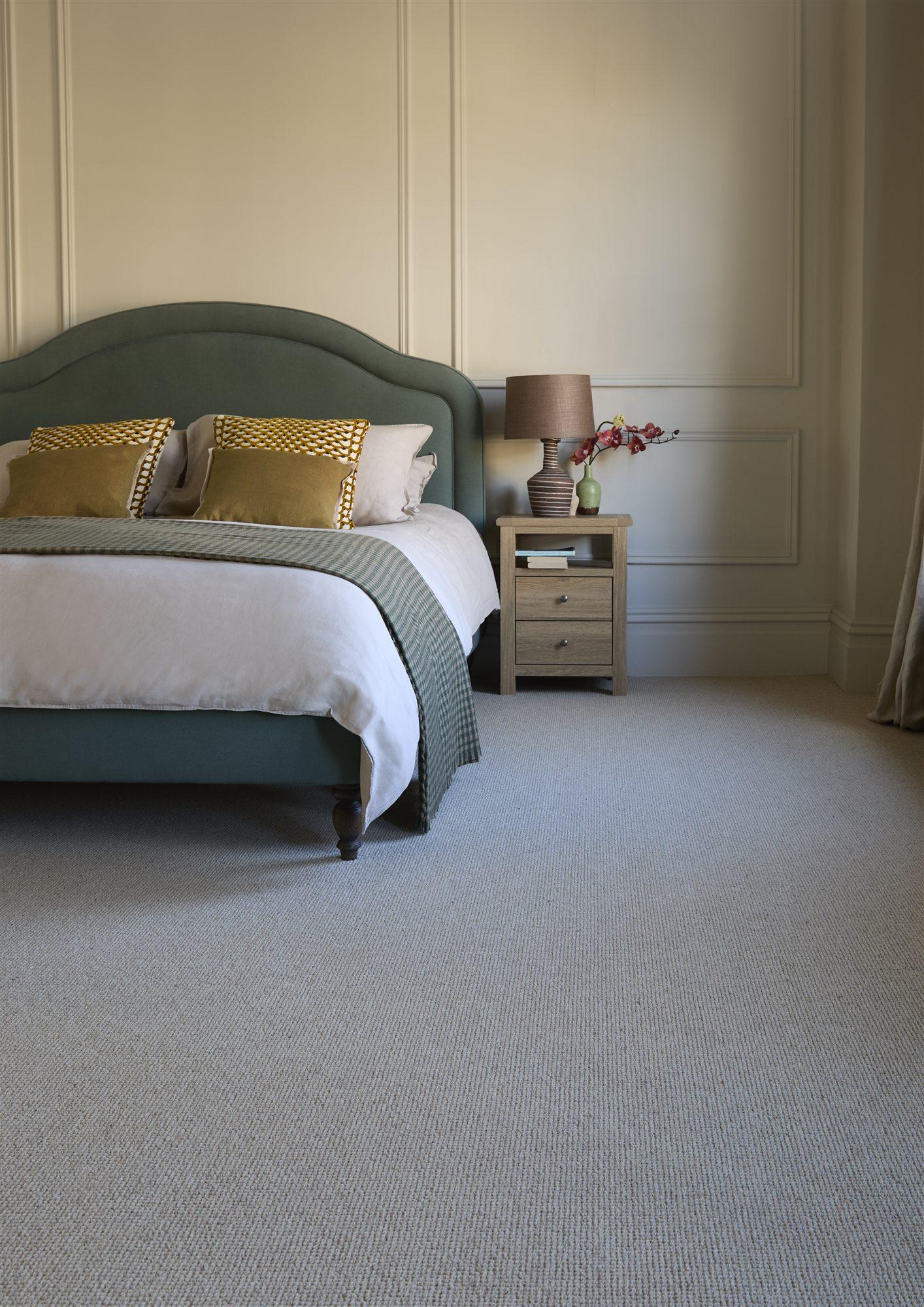 Trilogy Brontë carpet, bedroom
 Stairs and landing, bound edge
 Landing from above
 Tartan carpet, hotel corridor
Questions we’re asked.
Straight answers from the people who’ll fit your floor. Anything else, ask us in the showroom.
Wool or synthetic carpet?
Once you've told us which area the carpet is for, our sales team will suggest the ideal product. For high-traffic areas, an 80% wool / 20% synthetic or a 100% wool carpet will keep its body longer than a synthetic one. Because 100% wool naturally pills, an 80/20 is easier to live with day to day (less hoovering).
For areas prone to spills, a synthetic bleach-cleanable carpet may be more practical. Synthetics are now made with stain-safe technology, the modern equivalent of Scotchguarding. They're ideal for children's bedrooms and playrooms, and popular anywhere in the home.
Underlay or feltback?
Underlay gives a carpet extra protection against wear and tear. We fit a high-density foam underlay as standard, whichever room we're carpeting. Your carpet lasts longer, feels better underfoot and, in older properties, helps with heat loss.
Feltback carpets have an underlay built into their backing and can be laid straight to the floor, which can be more cost-effective. In high-traffic areas we'd generally still recommend an additional underlay.
Vinyl or laminate?
Vinyl is now far more realistic, and it's quicker to install because it comes in sheet form. In homes it's generally loose laid, so if you change your mind in a few years it's easy to lift. Made with kitchens and bathrooms in mind, vinyl is a breathable membrane that won't warp if water gets underneath it.
Which thickness of laminate?
Our laminates run from 10 mm up to 14 mm. Generally, the thicker the board, the more robust the click-and-groove system is on an uneven subfloor.
We fit a 5 mm acoustic underlay as standard under all our laminate, which absorbs small differences in the subfloor. If there's a question mark over the levels, we'd usually advise a thicker board.